
Zapp! English Listening 2.11 - Things in the House

Taught by Tom Wilkinson — Cambridge CELTA
Recorded and taught by a team of British and North American English teachers, based in Oxford (UK) and Barcelona (Spain).
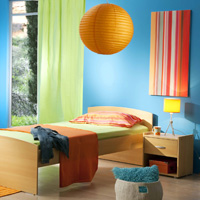 Alec has a problem with his new bedroom. "the whole room is exactly the length of me", he says, so "my feet touch one wall...when I'm in bed. And my head touches the other". He calls it manageable. That's the tone of this episode: six people describing the rooms they actually live in, complete with tiny kitchens, single beds they wish were bigger, and one television deliberately hidden away. Real homes, real complaints, and plenty of everyday vocabulary for furniture and space.
What you'll hear in this episode
The episode is built from three listening tasks. In the first, Nicholas and Ronny describe their rooms. Nicholas walks us through a studio apartment — bathroom on the right, a queen size bed, a cushion on the floor, a desk or two — and admits that wherever he lives, "I never have a TV". The current place does have one, but "it's tucked underneath one of the dressers". He then compares it with a much larger American home of about four hundred and fifty square feet, with a master bathroom, a Jacuzzi bathtub and a walk-in closet, and says he appreciates what he has now "In a different way".
Ronny's bedroom "isn't quite as big as I would like", but it's cosy and carefully chosen, right down to a crooked wall: "the irregular wall adds interest, to the room, architecturally". She ends by calling it "my little personal room".
In the second task, Sandra describes what she calls "a half a kitchen I guess you would call it" — a refrigerator, a microwave, a hotplate that cooks one thing at a time, one cupboard, and a sink that's too low. When she really gets going, dirty dishes go everywhere: "I'm pretty good at...at just kind of shoving things around and piling it up and moving it around". It is, she says, "really tiny and sparse".
Then Katie sits down with Kim and Alec, who have just moved, to ask about favourite rooms — sofas, sunshine, balconies, and a kitchen so small they avoid it.
Quick facts
| Episode | Zapp! English Listening 2.11 – Things in the House |
| Pack | Listening 2 |
| Level | 2 |
| Duration | 12 minutes 37 seconds |
| Audio | Free |
| Workbook | Included in the €39 all-in-one pack |
What you'll learn
The obvious gain is vocabulary for rooms and furniture, but the more useful gain is hearing how differently two varieties of English name the same objects. In one description you get closet, refrigerator, dresser and queen size bed; in the conversation with Katie you get flat, lounge and balcony. One speaker even flags the difference herself, mentioning what "we in America call a double bed".
You'll also practise listening through repair and restarting, which is what real speech is made of. You'll hear "almond orchi...almond orchards" corrected mid-word, and sentences that change direction halfway. Training your ear to hold on while a speaker rebuilds a sentence is a skill you can't get from scripted audio.
The tasks themselves teach selective listening: in the first one you don't transcribe anything, you simply decide which topics — size, cost, who they live with, beds — actually come up. Two of the four do, one doesn't, and one is mentioned by both speakers. Later you listen for a single answer: is Sandra's kitchen big or small?
Finally, there's some quietly useful conversational language. Kim's "a kitchen can really feel like the...the heart" of the house, finished with a tag question, and Katie's admission that she likes to "lie about on the sofa", are both phrases you can borrow the next time someone asks about your home.
Vocabulary from the workbook
The glossary covers four words that come up in the descriptions:
- dresser (noun) – a piece of furniture with drawers; it's where Nicholas's television ends up
- orchards (noun) – fields where fruit trees grow; almond orchards surrounded one of the homes described
- rural (adjective) – away from the city in a country area
- closet (noun) – the American word for wardrobe, where you hang your clothes; here it's a walk-in one with a little chair inside
What's in the workbook
The workbook takes you through the three listening tasks with the question set out before each recording, then an answers section that explains each one — including why "who they live with" isn't a correct answer for the first task.
After the summary there are extra listening questions covering all three recordings: whether Nicholas likes televisions, two ways his two homes differed, whether Ronny is happy with the size of her bed, one reason some Thai apartments have no kitchen, and whether Kim spends much time in her kitchen now. Answers are at the back, with a full transcript so you can check exactly what was said if you get one wrong.
There's also a guessing from context exercise. You take three lines from the recordings, decide whether the word in bold is a noun, verb, adjective or phrase, and match it to a definition: deceased, leftovers and shoving. The glossary above rounds it off.
The workbook for this episode is part of the all-in-one pack, which includes the workbooks for every Zapp! English episode for €39.
Get the complete courseAll workbooks and audio — €39
Is the English scripted?
The conversations aren't. Nicholas, Ronny, Sandra, Katie, Kim and Alec are all speaking off the cuff, which is why you hear coughs, restarts and unfinished sentences. The teaching sections that set up each task and give the answers are scripted, so the instructions stay clear.
Is this too hard if I'm not confident yet?
This is a Level 2 episode, and the tasks are deliberately forgiving: you're picking topics or choosing between big and small, not writing down every word. Listen once for the answer, then again with the transcript.
Do I need the workbook to use the audio?
No — the audio is free and the tasks and answers are spoken aloud. The workbook is what turns 12 minutes of listening into a full lesson, with the extra questions, the vocabulary work and the transcript.
What topic vocabulary does it cover?
Rooms, furniture and kitchen equipment, plus the language people use to complain politely about space: cosy, tiny, sparse, manageable.
Which conversation is best for a second listen?
Sandra's kitchen. It's one long, unbroken description packed with concrete nouns, and it rewards a second pass.
Get this episode
To save the audio, right-click the MP3 link and choose Save link as.
Listen on

